

Table of Contents
- Understanding Price Action Trading
- Key Concepts of Price Action
- Why Opt for Price Action Trading?
- Price Action Trading Strategies
- Common Tools for Price Action Traders
- Risk Management in Price Action
- Conclusion
In the dynamic world of Forex trading, there are numerous strategies designed to help traders analyze the market’s complexities. Among them, price action trading stands out due to its focus on simplicity and understanding market behavior based purely on price movements, rather than relying heavily on technical indicators or news-based analysis.
This guide provides an in-depth look at price action trading, how it works, and how it can be applied to analyze Forex market trends with practical examples.
Understanding Price Action Trading
Price action trading is a strategy where decisions are made based on the movement of asset prices over time. It primarily uses historical price data, often displayed through candlestick charts, to identify trends, reversals, and potential trading opportunities. Unlike methods that depend on technical indicators or fundamental analysis, price action focuses on real-time price movement.
At its core, price action trading involves:
- Interpreting market behavior through patterns like candlesticks, trendlines, support, and resistance.
- Reacting to current price movements rather than relying on lagging indicators.
- Adapting to changing market conditions as price action can evolve quickly.
Key Concepts of Price Action Trading
To trade effectively using price action, it’s crucial to grasp its fundamental concepts. These include:
Candlestick Patterns
Candlestick patterns form the backbone of price action analysis. Each candlestick represents price movement over a specific period and includes the following elements:
- Open: The price at the start of the period.
- Close: The price at the end of the period.
- High: The highest price reached.
- Low: The lowest price touched.
Common candlestick patterns include:
- Hammer and Inverted Hammer: These may signal reversals at key market levels.
- Hammer: Appears at the bottom of a downtrend, suggesting a bullish reversal.
- Inverted Hammer: Indicates a possible reversal at the end of a downtrend.
- Doji: Formed when the open and close are nearly the same, indicating market indecision and often preceding significant price moves.
- Engulfing Patterns: Can be bullish or bearish.
- Bullish Engulfing: A large green candlestick engulfs the previous red candlestick, suggesting strong buying momentum.
- Bearish Engulfing: A large red candlestick swallows the previous green one, signaling selling pressure.
For example, if EUR/USD shows a bullish engulfing pattern after a downtrend, it could indicate a reversal, suggesting a buy opportunity.
Support and Resistance Levels
These levels represent key price points where the market tends to reverse or pause.
- Support: A price level where a downtrend halts and reverses upward due to strong buying activity.
- Resistance: A price point where upward movement slows or reverses due to strong selling pressure.
For example, if GBP/USD reaches a resistance level at 1.2500 and forms a bearish candlestick, it may signal a sell opportunity.
Trendlines
Trendlines help visualize market direction by connecting significant price highs or lows. The types of trends are:
- Uptrend: A series of higher highs and higher lows.
- Downtrend: A series of lower highs and lower lows.
- Sideways Trend: Price moves within a range without clear direction.
Chart Patterns
Chart patterns form on price charts and indicate future price movements. These patterns fall into two categories:
- Reversal Patterns: Indicate a shift in trend direction.
- Continuation Patterns: Suggest the existing trend will continue.
Common chart patterns include:
- Head and Shoulders: A reversal pattern signaling a trend change from bullish to bearish.
- Double Top and Double Bottom: A reversal pattern where the price tests the same level twice before reversing.
- Triangles (Ascending, Descending, Symmetrical): Continuation patterns suggesting a potential breakout.
For instance, a Double Bottom on AUD/USD near support might signal a bullish reversal and provide a buying opportunity.
Key Levels
These are significant price points, often round numbers (e.g., 1.0000 or 1.5000), acting as psychological barriers. They serve as major support or resistance levels where price action may show strong reactions.
Why Opt for Price Action Trading?
Price action trading has become popular due to its simplicity, versatility, and effectiveness. Here are some reasons why traders prefer this approach:
- Simplicity: By eliminating the need for multiple technical indicators, price action trading focuses directly on price movements, making it easier to understand.
- Versatility: This strategy can be applied to any timeframe, from short-term intraday trading to long-term investments. Whether you are tracking minute-by-minute changes or evaluating weekly trends, price action is adaptable.
- Real-time Insights: Price action provides immediate feedback on market behavior, offering traders a clear, real-time understanding of price dynamics without waiting for indicators to react.
- Adaptability: Price action can be used in various market conditions:
- Trending Markets: Helps identify optimal entry points in the direction of the trend.
- Range-bound Markets: Highlights buy and sell opportunities at key support and resistance levels.
- Volatile Markets: Provides quick signals for breakouts or reversals.
Price Action Trading Strategies
Here are some common strategies used in price action trading:
Breakout Trading Strategy
A breakout occurs when the price decisively moves above resistance or below support levels, often with higher volume. The breakout strategy focuses on entering trades when the price breaks out of a consolidation range.
Steps for Breakout Trading:
- Identify clear support and resistance levels.
- Wait for a breakout candle to close beyond these levels.
- Enter a trade in the direction of the breakout.
- Confirm the breakout with volume spikes for added reliability.
This comprehensive guide introduces the core concepts and strategies of price action trading. By understanding how to read market behavior and utilizing key tools like candlestick patterns, trendlines, and support/resistance levels, traders can gain an edge in the dynamic Forex market.
Get high-accuracy trading signals delivered directly to your Telegram. Subscribe to specialized packages tailored for the world’s top markets:
Free Crypto Signals Subscribe via Telegram
Free Forex Signals Subscribe via Telegram
Free VIP Signals (Gold, Oil, Forex, Bitcoin, Ethereum, Indices) Subscribe via Telegram
Free Trading Acoount Open With ORON LIMITED Signals (Gold, Oil, Forex, Bitcoin, Ethereum, Indices)
Open Account
Not profitable? Don’t worry! Join our copy trading system where we provide lower risk returns. Benefits of Joining Us:
-Lesser Risk as lot size is minimal
-Higher returns (approx. 5% to 10% monthly)
-Easy Deposit and Withdrawal with USDT using crypto wallets
-Lesser Drawdown
-Instant Support
-Invest Now and get guaranteed returns with us. DM us for more info❤️
-Start Now
*Copy Trading is free but we charge some percentage of profit as fees.*
Full VIP signals performance report for September 22–26, 2025:
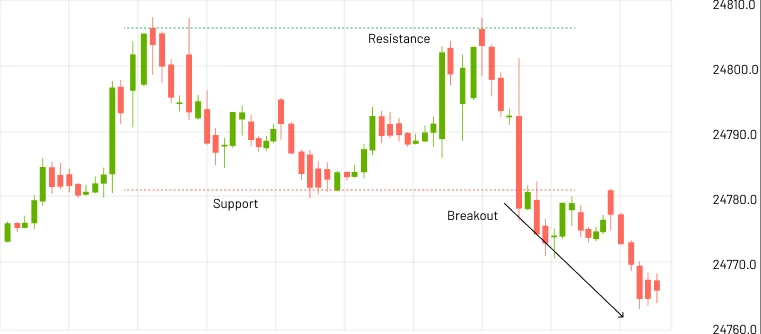
Breakout Trading Strategy
Suppose USD/JPY is consolidating between 134.00 (support) and 135.00 (resistance). In this scenario, if the price breaks above 135.00, traders might consider entering a long position, targeting the next resistance at 136.00.
Pullback Trading Strategy
A pullback is a temporary price retracement within a broader trend, creating an opportunity to enter the trend at more favorable prices. Pullback trading involves taking advantage of these short-term reversals to align with the overall market direction.
Steps for Trading with a Pullback Strategy:
- Identify the trend using tools like trendlines or moving averages.
- Wait for the price to retrace to a significant support or resistance level.
- Look for price action signals (such as pin bars) that suggest the trend will continue, then enter the trade with a stop-loss placed below (for a long trade) or above (for a short trade) the pullback level.
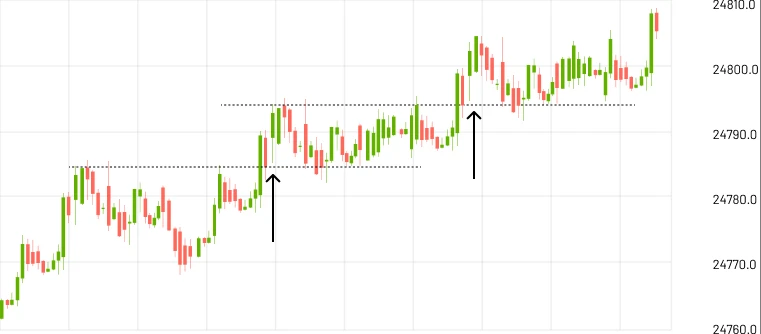
Pullback Trading Strategy
For example, during an uptrend in AUD/USD, the price pulls back to a key support level and forms a bullish engulfing candle. In this case, traders could enter a buy trade, aiming for the next swing high as the trend resumes.
Inside Bar Trading Strategy
An inside bar is a smaller candlestick that fits entirely within the range of the previous candlestick (known as the mother bar). This pattern is often used to indicate a potential breakout, consolidation, or market indecision.
Steps for Trading with an Inside Bar Strategy:
- Identify an inside bar within an existing trend.
- Place a buy-stop order above the high of the mother bar for a bullish breakout, or a sell-stop order below its low for a bearish breakout.
- Set a stop-loss just beyond the opposite end of the inside bar to manage risk effectively.
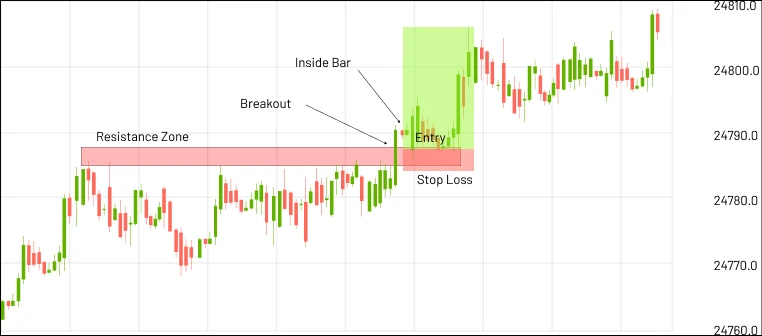
Inside Bar Trading Strategy
For example, during an uptrend in GBP/USD, an inside bar forms after a strong bullish candle. In this case, traders might place a buy order just above the high of the mother bar, anticipating the trend to continue upward.
Pin Bar Trading Strategy
A pin bar is a candlestick pattern characterized by a small body and long wicks (shadows), which indicate a strong rejection of price at a specific level. The direction of the wick reveals where the price was rejected, suggesting a potential trend reversal.
Key Features of a Pin Bar:
- A small body (real range) relative to the long wick.
- The wick should be at least twice the length of the body.
- Typically forms at significant support or resistance levels.
Steps for Trading with a Pin Bar Strategy:
- Identify a pin bar near key support or resistance levels, or within an ongoing trend.
- Enter a trade in the opposite direction of the wick (e.g., if the wick is pointing upward, consider selling).
- Set a stop-loss just beyond the end of the wick to manage risk effectively.
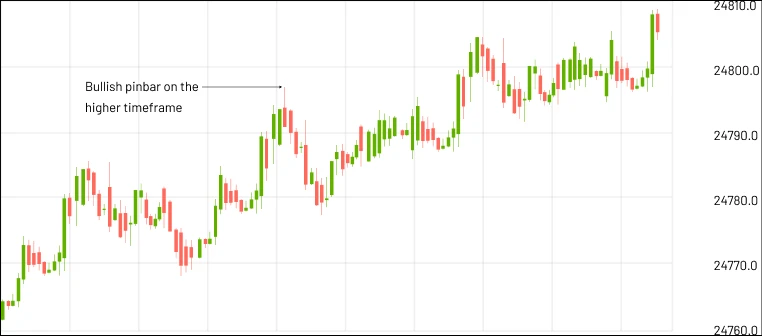
Pin Bar Trading Strategy
For example, on the EUR/USD chart, if a bullish pin bar forms at 1.1000 (a support level), it signals a rejection of lower prices. Traders may place a buy order above the pin bar’s high, targeting the next resistance level.
Trendline Bounce Trading Strategy
A trendline is a diagonal line connecting consecutive highs (in a downtrend) or lows (in an uptrend), showing the market’s trend direction. Price often respects trendlines, making them valuable for identifying potential entry and exit points.
Steps to Trade a Trendline Bounce:
- Draw trendlines connecting significant swing highs and lows.
- Wait for the price to touch the trendline and show rejection, such as a pin bar or engulfing candle.
- Enter a trade in the direction of the trend, placing a stop-loss just beyond the trendline.
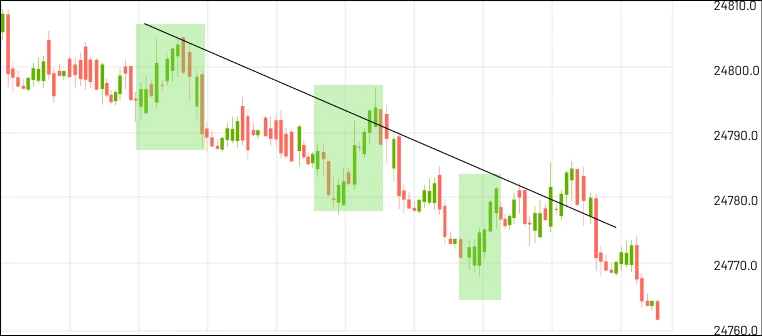
Trendline Bounce Trading Strategy
For example, on AUD/USD during an uptrend, the price may pull back to touch the trendline and form a bullish pin bar. Traders can enter a buy trade, aiming for the next swing high.
Reversal Trading Strategy
Reversals happen when the price changes direction after reaching a key high (resistance) or low (support). Traders look for patterns like double tops and double bottoms to anticipate potential trend changes.
Steps to Trade a Reversal:
- Identify reversal patterns such as double tops/bottoms or candlestick reversal signals.
- Confirm with weakening momentum near the extreme levels.
- Enter trades in the direction opposite to the previous trend.
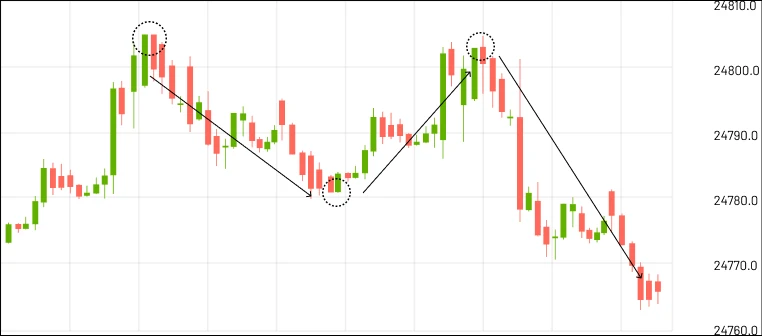
Reversal Trading Strategy
For example, on the GBP/USD chart, a double top forms at 1.3500 (resistance), followed by a bearish engulfing candle. Traders can enter a short position, aiming for the next support level at 1.3300.
Fakey Strategy
A fakey occurs when the price temporarily breaks out of a key level but quickly reverses, trapping breakout traders and creating an opportunity to trade in the opposite direction. This strategy focuses on spotting false breakouts and potential reversals.
Steps to Trade the Fakey Strategy:
- Identify a false breakout beyond a significant support or resistance level.
- Confirm the reversal using candlestick patterns like engulfing or pin bars.
- Enter a trade in the direction opposite to the false breakout.
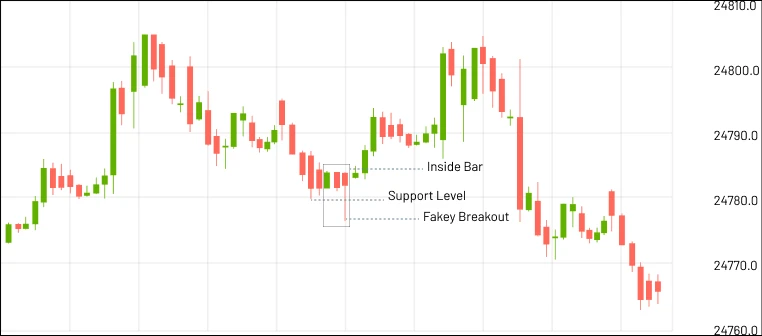
Fakey Strategy
Example: If USD/JPY breaks above the 140.00 resistance but quickly reverses and closes below it, traders can enter a short position, targeting the previous support level.
Three-Bar Reversal Strategy
This strategy identifies potential reversals using a sequence of three candles:
- A strong trend candle.
- A smaller indecision candle.
- A reversal candle moving in the opposite direction.
Steps to Trade the Three-Bar Reversal Strategy:
- Spot a three-bar reversal pattern near significant support or resistance levels.
- Enter a trade in the direction of the reversal candle.
- Place a stop-loss using the high or low of the three-bar sequence.
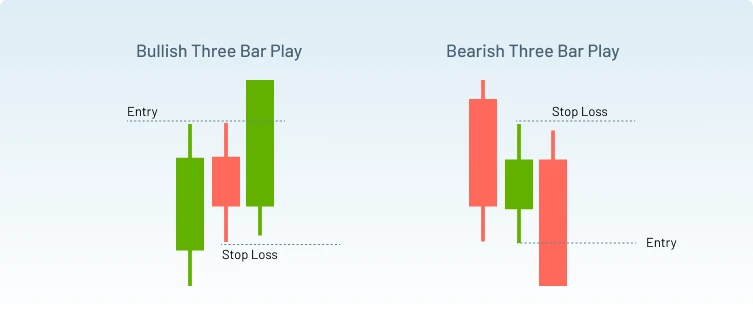
Three-Bar Reversal Strategy
Example: On GBP/USD, a bearish reversal may form after three bars at a resistance level. Traders can enter a short position targeting the next support level.
Essential Tools for Price Action Traders
While price action trading primarily relies on price movements rather than indicators, certain tools can complement analysis:
- Volume: Confirms the strength behind price movements.
- Fibonacci Retracement: Helps identify potential pullback or retracement levels.
- Moving Averages: Used selectively to highlight the overall trend without cluttering the chart.
Risk Management in Price Action Trading
Even with strong price action strategies, disciplined risk management is vital for consistent trading success and avoiding emotional decisions. Key practices include:
- Position Sizing: Risk only a small portion of your account per trade, typically 1–2%. This protects your capital even during losing streaks.
- Stop-Loss Placement: Set stop-loss levels based on support/resistance, trendlines, or key candlestick patterns like pin bars. Always aim for a favourable risk-to-reward ratio (e.g., 1:2 or 1:3), ensuring potential profits exceed potential losses.
- Avoid Overleveraging: Leverage can magnify gains, but excessive use increases risk. Moderate leverage helps maintain control over trades.
Conclusion
Price action trading is a cornerstone of Forex strategies, offering a clear and effective way to interpret market behaviour. By focusing on price patterns, key levels, and trendlines, traders gain insights into market psychology without relying heavily on complex indicators. Its flexibility makes it suitable for all experience levels and timeframes. However, disciplined risk management remains essential to navigate the challenges of trading successfully.
Get high-accuracy trading signals delivered directly to your Telegram. Subscribe to specialized packages tailored for the world’s top markets:
Free Crypto Signals Subscribe via Telegram
Free Forex Signals Subscribe via Telegram
Free VIP Signals (Gold, Oil, Forex, Bitcoin, Ethereum, Indices) Subscribe via Telegram
Free Trading Acoount Open With ORON LIMITED Signals (Gold, Oil, Forex, Bitcoin, Ethereum, Indices)
Open Account
Not profitable? Don’t worry! Join our copy trading system where we provide lower risk returns. Benefits of Joining Us:
-Lesser Risk as lot size is minimal
-Higher returns (approx. 5% to 10% monthly)
-Easy Deposit and Withdrawal with USDT using crypto wallets
-Lesser Drawdown
-Instant Support
-Invest Now and get guaranteed returns with us. DM us for more info❤️
-Start Now
*Copy Trading is free but we charge some percentage of profit as fees.*
Full VIP signals performance report for September 22–26, 2025:
