
Understanding the Descending Channel Pattern in Trading
Recognizing different patterns in technical analysis is like having a roadmap for smarter trading decisions and strategy building. Whether you trade Forex, stocks, or cryptocurrencies, understanding these patterns can provide valuable insights into market direction and potential profit opportunities. In this article, we’ll explore the Descending Channel Pattern, its key features, and practical tips traders can use.
What Is the Descending Channel Pattern?
Patterns play a crucial role in technical analysis, helping traders interpret price movements and develop effective strategies. There are many patterns, including horizontal and ascending channels, triangles, candlestick formations, and more. Here, we’ll focus on the Descending Channel Pattern.
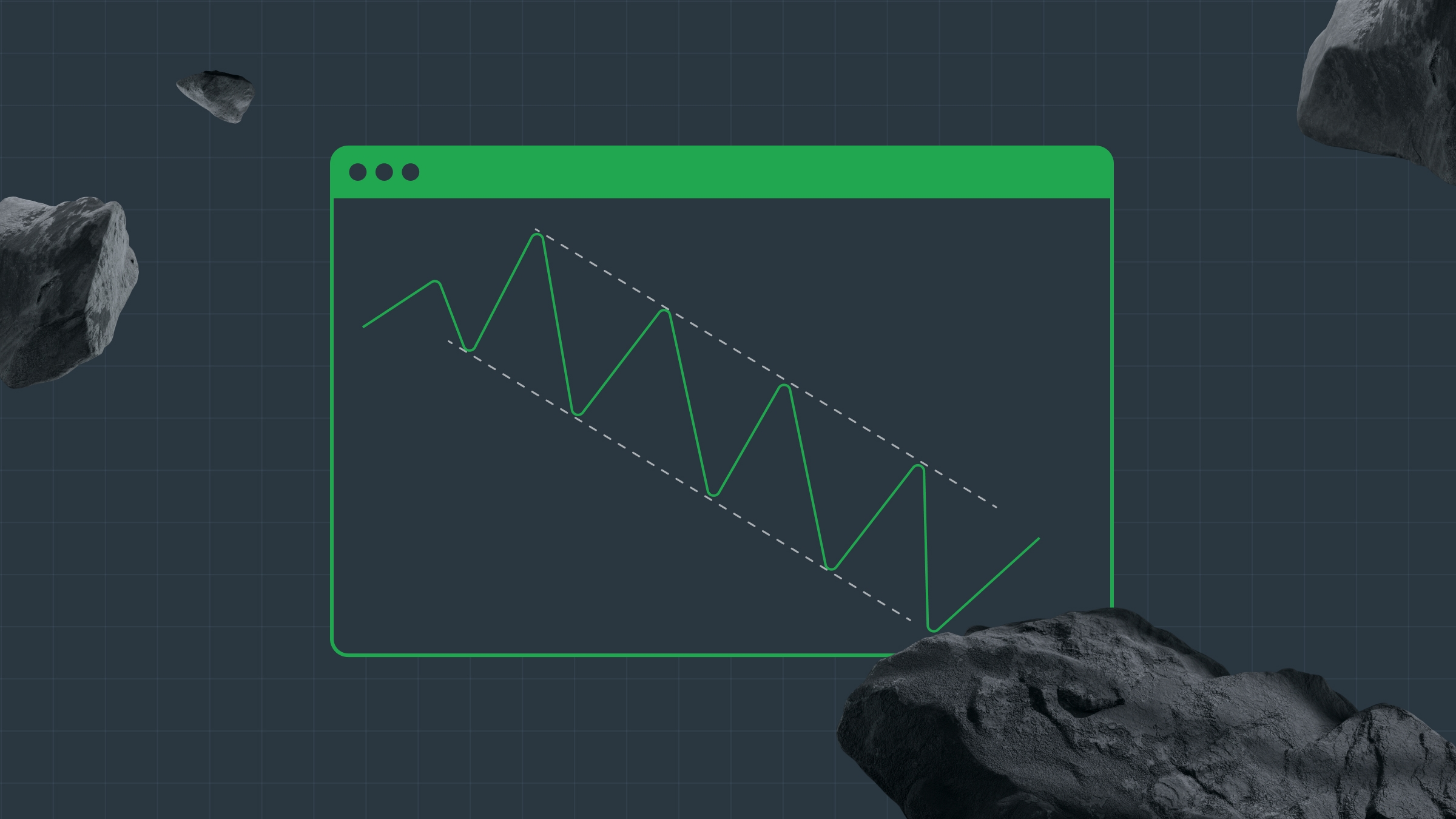
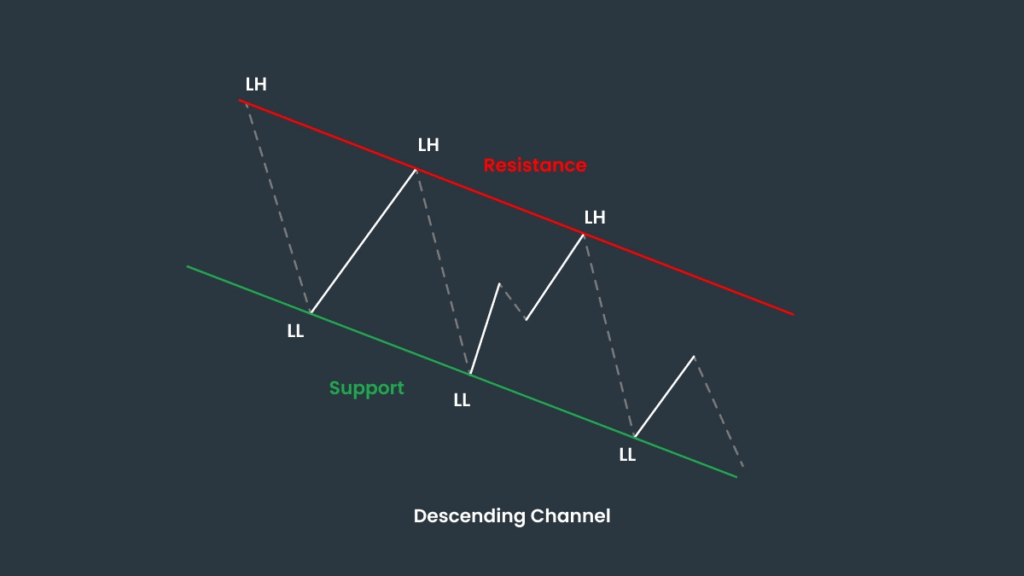
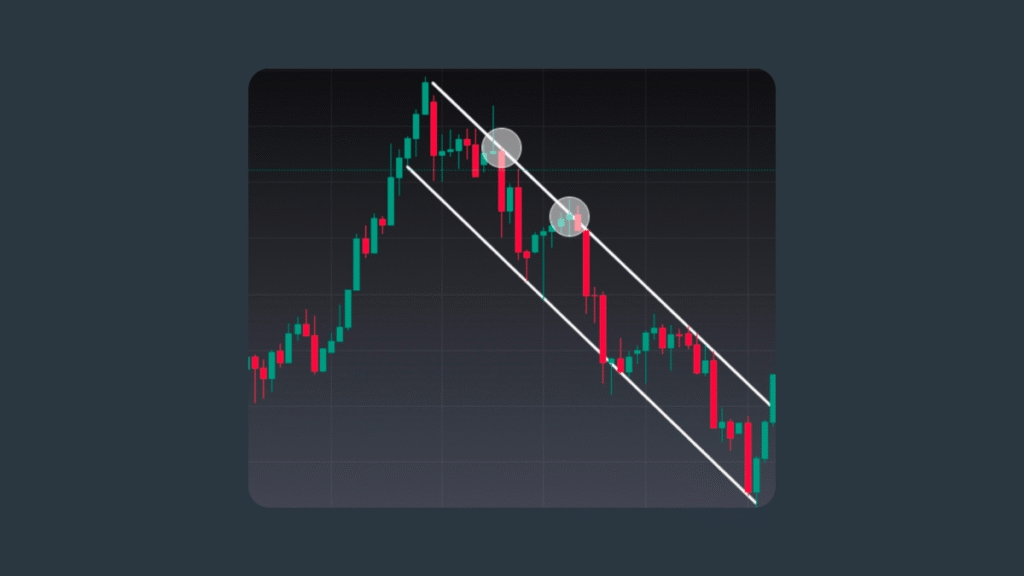
A Descending Channel forms when the price moves downward between two parallel trendlines, creating a series of lower highs and lower lows. As price oscillates within these lines, it establishes a clear downward corridor: each rally peaks lower, and each decline bottoms lower.
Typically, the Descending Channel is seen as a bearish continuation pattern, but it can sometimes signal a reversal, depending on its position within the broader market trend.
For a deeper understanding of key trading patterns and how to use them, check out the FBS article: Common Trading Chart Patterns You Should Know.
How to Distinguish a Descending Channel from Similar Patterns
Correct pattern recognition is essential because confusing patterns can lead to trading mistakes. Here’s how the Descending Channel differs from others:
1. Descending Channel vs. Falling Wedge
- Both move downward, but a Falling Wedge narrows over time as the trendlines converge. This often signals weakening momentum and a potential bullish reversal.
- A Descending Channel, by contrast, has parallel lines, usually indicating a continuation of the bearish trend.
2. Descending Channel vs. Bull Flag
- A Descending Channel forms within a broader downtrend and should not be assumed as a bullish signal.
- A Bull Flag occurs during strong uptrends, tilts downward, and represents a temporary pullback before the uptrend resumes.
3. Descending Channel vs. Rectangle
- A Descending Channel slopes downward, showing a controlled pattern of lower highs and lower lows.
- A Rectangle has horizontal support and resistance, reflecting sideways consolidation rather than a downtrend.
Recognizing these distinctions helps traders avoid mistakes, such as treating a channel like a wedge or flag, which could lead to trading against the prevailing trend.
How to Identify a Descending Channel
How to Identify a Descending Channel
To spot a Descending Channel, follow these steps:
- Draw the Trendlines:
- Connect two or more lower highs to form the upper trendline, which acts as resistance.
- Connect two or more lower lows to form the lower trendline, which serves as support.
- Aim for at least four contact points (two highs and two lows) to confirm a valid channel.
- Check the Shape:
- Both trendlines should slope downward and remain roughly parallel.
- Observe Price Behavior:
- Price typically bounces between the trendlines until a breakout occurs.
- If the price fails to touch or break the lower trendline after several swings, it may indicate seller exhaustion, hinting that the downtrend is weakening and a bullish breakout could be near.
A Descending Channel represents a controlled selling trend, where the price declines steadily rather than collapsing abruptly.
How to Confirm or Reject a Channel
- A valid channel requires at least two touches on both the upper and lower boundaries (four points total). More touches increase reliability.
- Both trendlines must slope downward; if they flatten, the pattern resembles a rectangle instead.
- Trendlines should remain roughly parallel; if they converge, the pattern is a Falling Wedge, not a channel.
- If the price breaks through the boundaries repeatedly without reaction, the channel is no longer valid.
Trading Strategies for the Descending Channel Pattern
Every pattern requires a tailored approach. Below are strategies for trading the Descending Channel Pattern—choose the ones that best match your goals and trading style.
1. Breakout Strategy (Bullish Reversal)
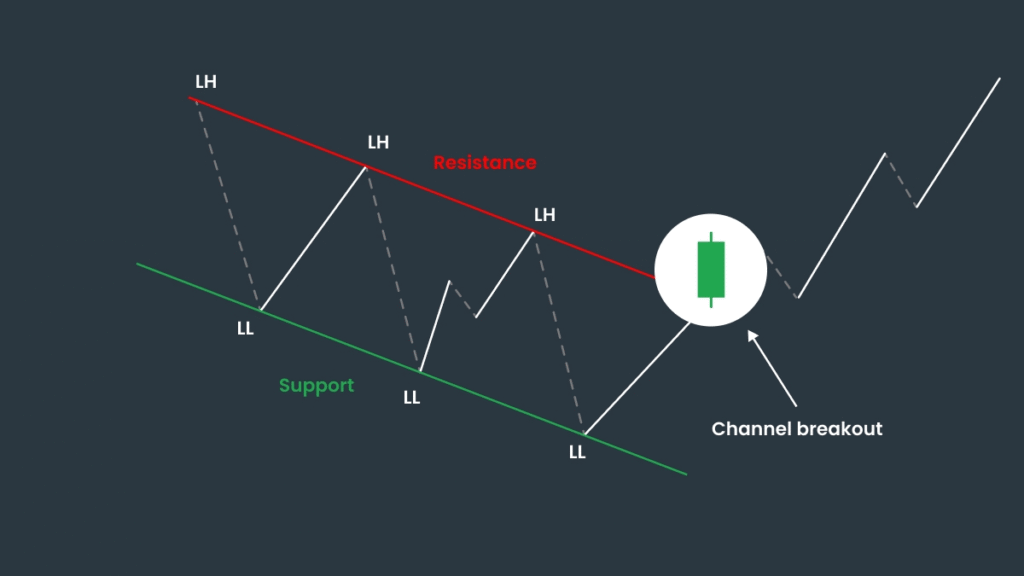
When price breaks above the upper resistance line, especially with strong momentum or high volume, it often signals the end of the downtrend and the beginning of a new upward movement.
This presents a potential bullish reversal and a prime opportunity to enter a long position.
How to trade it:
- Entry: Wait for a candle to close clearly above the upper resistance. Avoid entering mid-breakout; confirmation on the candle close reduces the risk of a false breakout.
- Stop-loss: Place it just below the last swing low or beneath the lower channel line to guard against failed breakouts.
- Target: Measure the height of the channel (distance between support and resistance) and project that distance upward from the breakout point.
2. Range-Bound Strategy (Trading Within the Channel)
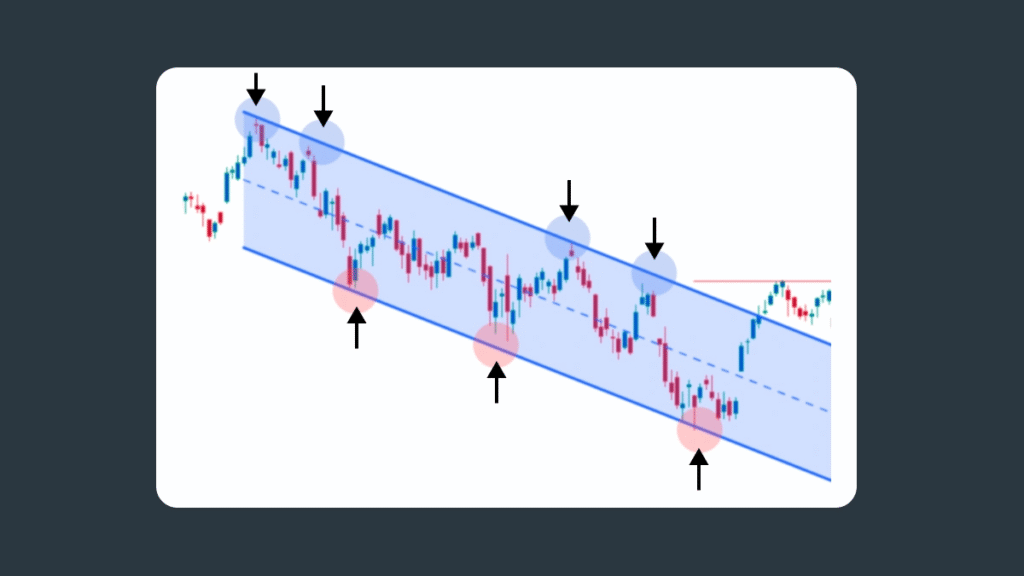
Not all traders wait for a breakout; some prefer to trade within the trend, favoring a more predictable and lower-risk approach. Within a Descending Channel, price typically bounces between the upper resistance and lower support lines, creating multiple opportunities to sell near the top and buy near the bottom. In such cases, the Third Touch Strategy can be an effective option.
Get high-accuracy trading signals delivered directly to your Telegram. Subscribe to specialized packages tailored for the world’s top markets:
Free Crypto Signals Subscribe via Telegram
Free Forex Signals Subscribe via Telegram
Free VIP Signals (Gold, Oil, Forex, Bitcoin, Ethereum, Indices) Subscribe via Telegram
Free Trading Acoount Open With ORON LIMITED Signals (Gold, Oil, Forex, Bitcoin, Ethereum, Indices)
Open Account
Not profitable? Don’t worry! Join our copy trading system where we provide lower risk returns. Benefits of Joining Us:
-Lesser Risk as lot size is minimal
-Higher returns (approx. 5% to 10% monthly)
-Easy Deposit and Withdrawal with USDT using crypto wallets
-Lesser Drawdown
-Instant Support
-Invest Now and get guaranteed returns with us. DM us for more info❤️
-Start Now
*Copy Trading is free but we charge some percentage of profit as fees.*
Full VIP signals performance report for September 22–26, 2025:
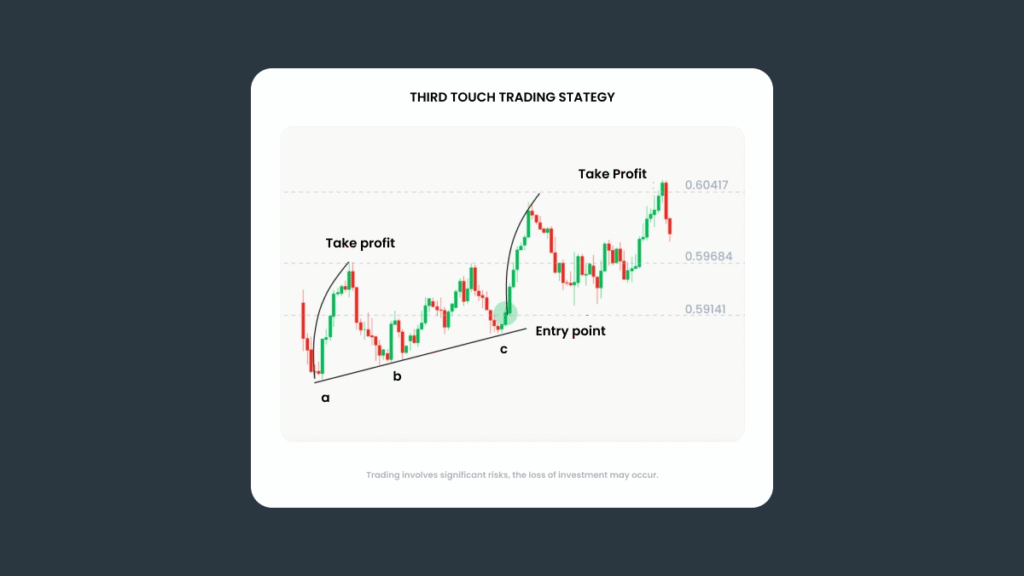
How to Determine the Entry Point: Third Touch Strategy
- First Touch: The price reaches either the support or resistance line but may bounce back.
- Second Touch: The price tests the same level again, usually with reduced momentum.
- Third Touch: The price hits the level once more, and this time the move has a higher probability of either reversing or breaking through.
Take-Profit: Aim for the opposite boundary of the channel, providing a reasonable target based on prior price behavior.
Stop-Loss: Place it a few pips below the support line or the most recent low to limit risk.
For more details, see the article: “The Third Touch Trading Strategy.”
3. Bearish Continuation (Breakdown) Strategy
Many Descending Channels continue in the direction of the prevailing downtrend. A strong bearish continuation setup occurs when the price breaks below the lower support line.
- Entry: Wait for a clear candle close below the channel’s lower boundary, ideally confirmed by rising volume or momentum indicators.
- Stop-Loss: Place it just above the last minor high within the channel, or above the broken support line, to protect against false breakdowns.
- Target: Measure the height of the channel and project it downward from the breakdown point, or use the next major horizontal support as your profit target.
This strategy leverages the trend’s strength but requires discipline—false breakdowns can trap early sellers. Always wait for confirmation before entering.
4. False Breakouts and Retests
Not every breakout from a Descending Channel succeeds immediately. False or premature breakouts are common, where price spikes outside the channel only to return inside.
A practical approach is to wait for a retest before entering:
- Bullish breakout: Wait for a pullback that confirms the old resistance as new support before entering a long position.
- Bearish breakdown: Wait for a pullback toward the broken support; if it holds as resistance, entering a short position is safer.
Invalidation: If the price re-enters and closes back inside the channel, treat the breakout as failed and step aside.
This retest strategy helps filter out fakeouts and provides clear levels for stop-loss placement, reducing the risk of being trapped.
Case Studies: Trading a Descending Channel
Example 1 — Bearish Continuation Breakdown
[This section can continue with a real or illustrative example showing entry, stop-loss, and target.]
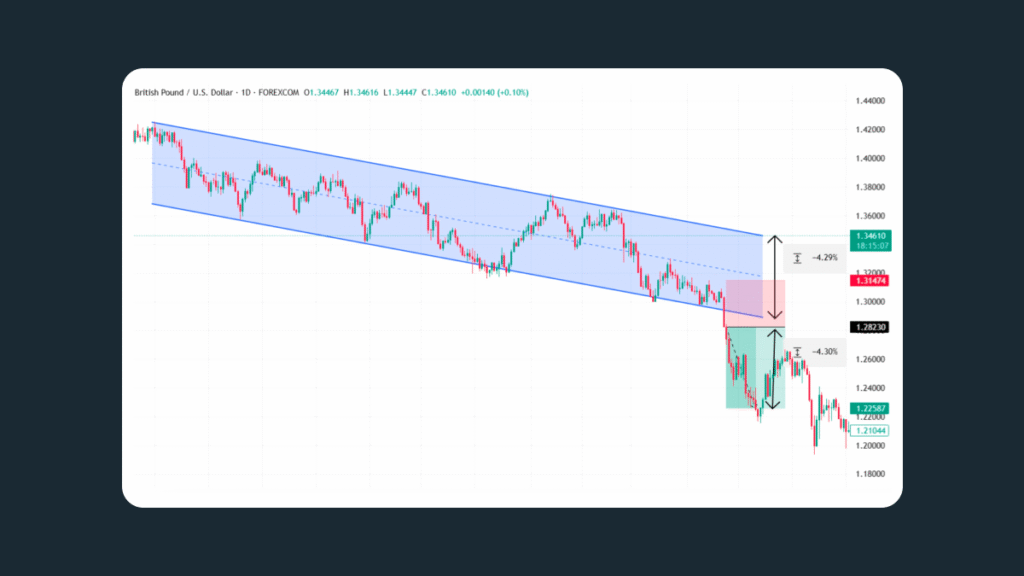
Example 1 — Bearish Continuation on GBP/USD
On this daily GBP/USD chart, the price remained within a Descending Channel for several months.
- Entry: Wait for a candle to close below the channel’s lower boundary.
- Stop-Loss: Place just above the most recent high.
- Target: Equivalent to the channel’s height, roughly a 4.3% move.
Result: A textbook bearish continuation with a clean breakdown.
Example 2 — Re-Entry Trade Inside the Channel
On this 4-hour USD/CHF chart, the price briefly spiked above the channel’s resistance before falling back inside, presenting a potential re-entry opportunity.
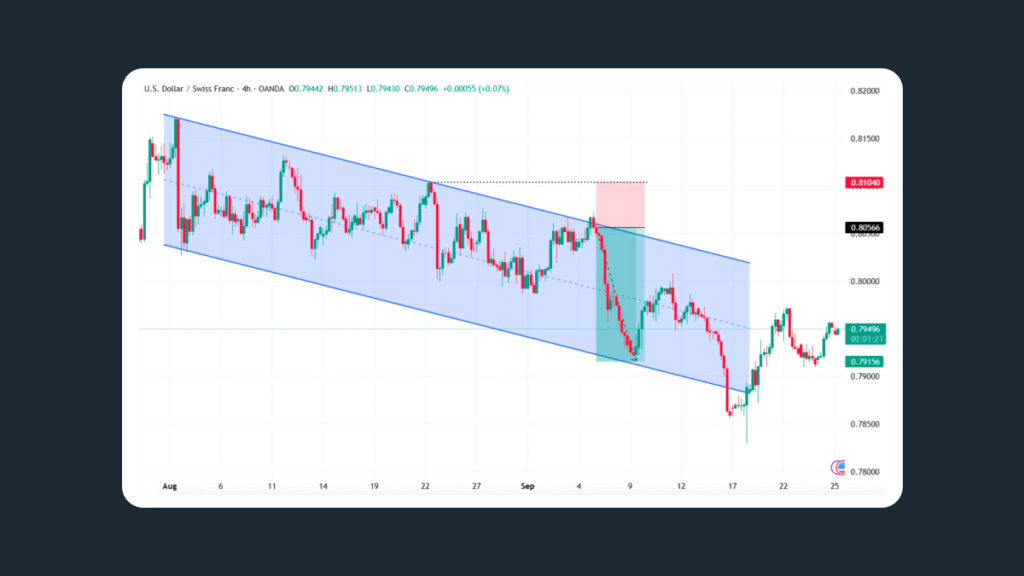
Entry, Stop-Loss, and Target Example
Entry: Enter after the candle closes back inside the channel following a false breakout.
Stop-Loss: Place just above the last touch of the upper boundary (around 0.8104).
Target: Aim for the lower boundary, near 0.7915.
Result: A clean short trade with a logical stop, capturing the move from the re-entry at resistance down to support.
Indicator Confluence and Volume Confirmation
A Descending Channel becomes more reliable when price action aligns with technical indicators. Combining indicators with volume analysis improves confidence in the pattern.
1. Volume Confirmation
Volume reflects market conviction. During a breakout, rising volume adds credibility, signaling strong participation. Low or declining volume suggests a weak breakout that may fail. Inside the channel, volume often shrinks during consolidation and expands when a new trend begins. In short, volume expansion is a green light, while collapse is a warning.
2. RSI and Momentum Alignment
Momentum indicators like RSI or Stochastic Oscillator help verify price movement:
- RSI oversold near the lower channel boundary may indicate sellers are losing strength and a bounce could occur.
- RSI overbought can warn of an impending downward swing.
- On breakouts above resistance, look for RSI crossing above 50 or Stochastic turning upward to confirm momentum shift.
3. Divergence
Divergence between price and momentum is a useful clue:
- Bullish divergence: Price makes lower lows, but RSI or MACD makes higher lows → signals weakening downside pressure and potential reversal.
- Bearish divergence: Price makes higher highs, but the indicator does not confirm → may precede a failed breakout or deeper decline.
4. MACD and Volume Synergy
MACD combined with volume enhances breakout reliability. Rising MACD histogram bars alongside increasing volume indicate strong participation. A MACD crossover above the signal line during a volume spike strengthens the odds of a successful breakout.
5. Combining Signals
A robust setup often includes multiple confirmations:
- Breakout above resistance
- Volume spike
- RSI above 50
- MACD turning positive
When 2–3 of these align, the setup is more reliable. If signals conflict with price action, it’s safer to wait. Strong confluence reduces guessing and increases high-probability trades.
Multi-Timeframe Context
Descending Channels are more meaningful when confirmed across multiple timeframes. Start from higher timeframes and work down to refine entries.
- Check Higher Timeframe (Daily or 4H)
Identify the dominant trend. If the higher timeframe is clearly bearish, a Descending Channel on a lower timeframe (1H or 15-min) often acts as a continuation pattern. - Move to Your Trading Timeframe
Look for the channel forming within the larger trend. Aligning with the higher timeframe reduces false signals. - Refine Entries on Lower Timeframes
Zoom in to refine entries near the channel line or during breakouts. For example, spotting a breakout on the 1H chart may allow for a cleaner entry on a 15-minute chart. - Watch for Counter-Trend Channels
Lower timeframe channels against the main trend may represent pullbacks rather than true continuations, offering potential buying opportunities if the higher timeframe trend remains strong.
A top-down approach ensures you trade with the flow of the broader market, giving more weight to channels that align across multiple timeframes.
Risk Management for Channel Trades
Even well-formed Descending Channels can trap traders with false breakouts. Proper risk management is essential.
1. ATR-Based Stop Placement
Use the Average True Range (ATR) to place stops based on market volatility:
- For breakouts above the channel, place the stop 1–1.5 ATR below the breakout candle or lower trendline.
- For bearish breakdowns, place the stop 1–1.5 ATR above the breakdown candle or upper trendline.
2. Position Sizing
Calculate position size to risk only a small portion of your account (1–2% per trade).
- Example: $10,000 account, 1% risk ($100), stop 50 pips, $1 per pip → Position size = 100 ÷ (50 × 1) = 2 mini lots.
3. Risk/Reward Ratio
Map potential reward vs. risk before entering:
- Breakout trades: Project channel height from breakout point.
- Range-bound trades: Target opposite boundary, stop just beyond nearest trendline.
- Aim for minimum 1.5:1 or 2:1 reward/risk. Skip setups that don’t meet this ratio.
4. Adapt to Market Conditions
- Volatile markets → wider ATR stops, smaller positions
- Calm markets → tighter stops, larger positions
Adjust to conditions to avoid overexposure.
ATR stops protect against noise, position sizing keeps losses consistent, and risk/reward planning ensures trades are mathematically favorable.
Pros and Cons of the Descending Channel Pattern
Pros:
- Easy to spot with clear trendlines
- Multiple trading opportunities: trend trading or breakout
- Works across Forex, stocks, and crypto
Cons:
- Not all breakouts are valid; false breakouts can trap traders
- Requires precise trendline drawing
- Less effective in sideways or low-volume markets
Common Mistakes to Avoid
Even experienced traders can make errors when working with Descending Channels, but these pitfalls can be avoided:
- Don’t trade without confirmation: Wait for a candle close, volume spike, or indicator signal before entering to avoid false breakouts.
- Don’t ignore volume or indicator signals: These tools provide insights into the strength of a potential breakout.
- Don’t neglect risk management: Always use stop-loss orders and set realistic profit targets. Trading without proper risk control, whether inside the channel or on a breakout, can quickly lead to losses.
FBS is a trusted broker offering guidance at every stage of trading.
Key Takeaways
- A Descending Channel forms during a bearish trend, with price moving lower between two parallel downward-sloping lines: resistance on top and support below.
- The pattern consists of three main elements:
- Upper line marking lower highs
- Lower line marking lower lows
- Price oscillating inside the channel
- Traders can use it to plan entries and exits: sell near resistance or wait for a breakout that could signal a reversal.
- The pattern isn’t always reliable—sideways markets can generate false signals, and strong trends may lose momentum suddenly.
FAQs
Is the Descending Channel reliable?
It can be, particularly on higher timeframes like daily or weekly charts, often confirming that the downtrend is intact. No setup is perfect, so always wait for confirmation before trading.
Which timeframes are best?
Descending Channels appear on any chart, from 5-minute candles to weekly. Shorter timeframes provide more setups but include more noise, while longer timeframes generally offer cleaner, more reliable channels.
Can I use RSI or Stochastic with this pattern?
Yes. For example, an oversold RSI at the lower channel line may indicate a potential bounce. Momentum indicators confirming a breakout can strengthen the trade signal.
Does the pattern always indicate continuation?
Not necessarily. While downtrends often continue, price may sometimes break above resistance, signaling a potential new uptrend. Always consider the broader market context.
Glossary
- Trendline: A line connecting highs or lows to show price direction.
- Support: A price level where selling slows and buyers step in.
- Resistance: A price level where buying slows and sellers push back.
- Breakout: When price moves decisively beyond a pattern boundary.
- Continuation Pattern: A setup suggesting the trend will likely continue.
- Reversal Pattern: A setup indicating the trend may weaken and reverse.
- RSI (Relative Strength Index): Measures momentum and signals overbought or oversold conditions.
- Stochastic Oscillator: Compares closing price to recent range, highlighting potential reversals.
- ATR (Average True Range): Measures typical price movement, used to set stop-loss levels.
- False Breakout (Fakeout): When price briefly breaks a pattern but returns inside, often trapping early traders.
Get high-accuracy trading signals delivered directly to your Telegram. Subscribe to specialized packages tailored for the world’s top markets:
Free Crypto Signals Subscribe via Telegram
Free Forex Signals Subscribe via Telegram
Free VIP Signals (Gold, Oil, Forex, Bitcoin, Ethereum, Indices) Subscribe via Telegram
Free Trading Acoount Open With ORON LIMITED Signals (Gold, Oil, Forex, Bitcoin, Ethereum, Indices)
Open Account
Not profitable? Don’t worry! Join our copy trading system where we provide lower risk returns. Benefits of Joining Us:
-Lesser Risk as lot size is minimal
-Higher returns (approx. 5% to 10% monthly)
-Easy Deposit and Withdrawal with USDT using crypto wallets
-Lesser Drawdown
-Instant Support
-Invest Now and get guaranteed returns with us. DM us for more info❤️
-Start Now
*Copy Trading is free but we charge some percentage of profit as fees.*
Full VIP signals performance report for September 22–26, 2025:
