
Even seasoned traders can struggle to anticipate market direction. How do you determine the optimal time to enter trades, and why do bursts of trading activity matter?
For successful trading, targeting the periods of highest volatility and activity is crucial—these peak periods are known as the “power hour.” In this article, we’ll explore what power hour stocks are, how to trade them, and how to leverage them for maximum profit.
Get high-accuracy trading signals delivered directly to your Telegram. Subscribe to specialized packages tailored for the world’s top markets:
Free Crypto Signals Subscribe via Telegram
Free Forex Signals Subscribe via Telegram
Free VIP Signals (Gold, Oil, Forex, Bitcoin, Ethereum, Indices) Subscribe via Telegram
Free Trading Acoount Open With ORON LIMITED Signals (Gold, Oil, Forex, Bitcoin, Ethereum, Indices)
Open Account
Not profitable? Don’t worry! Join our copy trading system where we provide lower risk returns. Benefits of Joining Us:
-Lesser Risk as lot size is minimal
-Higher returns (approx. 5% to 10% monthly)
-Easy Deposit and Withdrawal with USDT using crypto wallets
-Lesser Drawdown
-Instant Support
-Invest Now and get guaranteed returns with us. DM us for more info❤️
-Start Now
*Copy Trading is free but we charge some percentage of profit as fees.*
Full VIP signals performance report for September 22–26, 2025:
What Are Power Hour Stocks?
Trader activity peaks at the beginning and end of the trading day. While “power hour” isn’t a strictly defined 60-minute window, it generally falls within these periods:
- Morning: 09:30 – 10:30 ET (14:30 – 15:30 UTC)
- Afternoon: 15:00 – 16:00 ET (20:00 – 21:00 UTC)
Note: The New York Stock Exchange operates on Eastern Time, which shifts between EST (UTC-5) in winter and EDT (UTC-4) in summer. Double-check the current offset if you’re trading from outside the US.
On early-closure days (e.g., before certain US holidays), the session may end at 13:00 ET, making the power hour 12:00 – 13:00 ET.
High trader activity increases market volatility—this is when opportunities for profit are greatest.
Extended Hours: What You Should Know
US stocks also trade outside the standard 09:30 – 16:00 ET session:
- Pre-market: 04:00 – 09:30 ET
- After-hours: 16:00 – 20:00 ET
Key differences from regular hours:
- Liquidity is lower, meaning wider spreads and less predictable order fills.
- Most brokers allow limit orders only, not market orders.
- Volatility can spike around earnings releases or news events.
Extended trading is better suited for experienced traders. Beginners should note that prices can gap at the next day’s open, increasing overnight risk.
Factors That Influence Trading Activity
- Market open and close flows
- News and economic catalysts (earnings, headlines)
- Pre- and post-weekend adjustments
- Options expiration Fridays (OpEx), which often spike volume
The US market opens at 09:30 ET with the NYSE, the world’s largest exchange. As major players like the Chicago Mercantile Exchange join, trader activity rises, driving volatility.
Morning trading is popular because it allows traders to finish their business early. Afternoon activity surges as financial institutions close positions, typically between 15:00 – 16:00 ET.
Trader activity also picks up around weekends and following major company news. Keeping an eye on news feeds is essential for spotting these opportunities.
How to Identify Power Hour Stocks
Before trading during power hour, prepare a watchlist. The most active stocks generally share high volume and news catalysts.
- Scanners: Use market scanners to find top intraday gainers and losers, unusual volume, or stocks breaking key levels.
- News feeds: Earnings announcements, FDA approvals, analyst upgrades, and M&A headlines often trigger late-day moves.
- Volume leaders: Stocks trading 2–3× their average daily volume are prime candidates.
- Earnings calendar: Stocks reporting after the close often see late-day surges as traders position ahead.
- NYSE imbalance data: Around 15:50 ET, the NYSE publishes order imbalances, signaling potential last-minute swings.
Ideally, your watchlist should be ready before 15:00 ET to know which stocks are in play by the final hour.
Patterns by Day and Event
Not every power hour behaves the same—certain days and events make activity more pronounced:
- Fridays: Typically the most volatile as traders close positions and options contracts expire.
- Mondays: Activity rises as traders react to weekend news.
- Options expiration days (OpEx): High final-hour volume as contracts are rolled or closed.
- Earnings days: Stocks reporting after the close often see heavy activity as traders position ahead.
Understanding the calendar allows you to adjust expectations and manage risk effectively.
How to Take Advantage of Power Hour Stocks
By knowing when activity peaks, preparing a watchlist, and following key volume and news indicators, traders can capitalize on the volatility of power hour stocks for potential profits.
Professional traders favor stock market power hours because these periods offer high liquidity and increased trading volume.
A crucial aspect of successful trading is understanding the characteristics of different trading sessions. This knowledge allows you to use your time and resources efficiently.
During power hours, several strategies can be applied. Here are the most effective approaches:
Scalping
Scalping involves making very short trades, often lasting seconds or minutes. During power hours, this strategy can be even riskier due to widened spreads and heightened volatility. To manage risk, use tight stop-losses, partial exits, and limit orders to reduce slippage.
Experienced traders benefit from scalping during power hours, as the increased activity allows for faster trades and more potential profits.
Day Trading
Day traders typically focus on the first and last hours of the trading day, when liquidity peaks. Risk management is critical: set maximum loss limits, restrict the number of trades, and be aware of halts in volatile stocks. Day traders close all positions within the same day and may trade the same asset multiple times or across several assets.
Swing Trading
Swing traders leverage the power hour to enter and exit positions near the close, when liquidity is highest and closing prices provide confirmation. Avoid chasing late-day spikes; instead, plan entries over several days.
Swing trading requires analytical skills and flexibility to adapt strategies based on market conditions. While it can be complex to master, the rewards for disciplined traders are significant.
Power Hour Trading Strategies
General advice isn’t enough for power hour trading. Success comes from following clear setups with defined entry, exit, and risk management rules. Here are four popular strategies:
1. Range Breakout
Monitor the price range the stock has traded in during the day. If it breaks above or below this “box” with strong volume during power hour, trade in the direction of the breakout.
Example: A stock trades between $20.00–$20.50 all day. At 15:10 ET, it breaks above $20.50 on heavy volume—a buy signal.
2. Late-Day Reversal
After a strong intraday trend, power hour can trigger reversals. Look for signals like hammer candles, long wicks, or sudden pushes against the trend, confirmed by volume.
Example: A stock drops from $50 to $45, then forms a hammer at 15:10 ET and bounces to $46—a signal to go long.
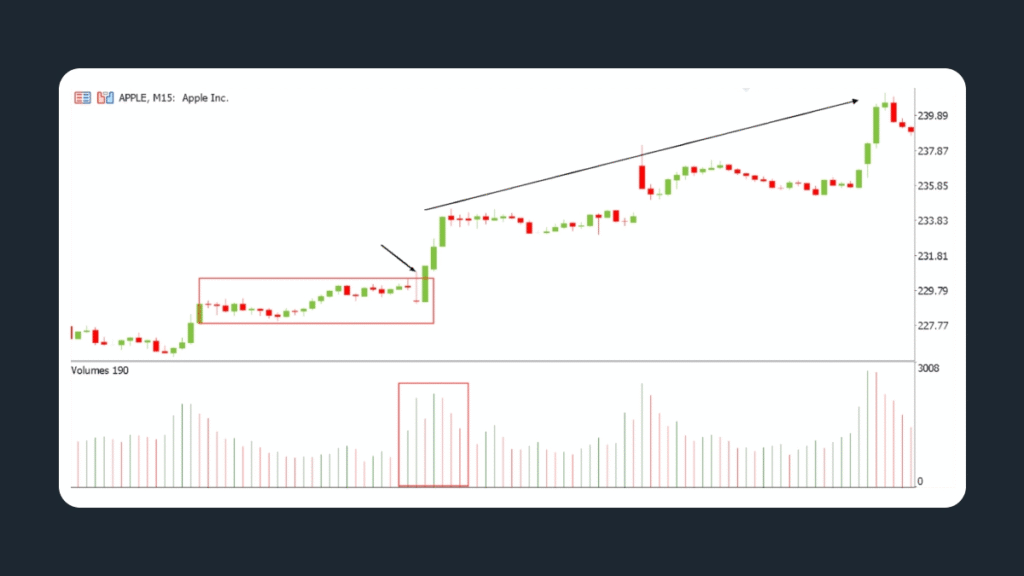
Case Study: Apple Opening Range Breakout
On a 15-minute chart, Apple formed an opening range between $228.50–$229.50 (red rectangle), with high volume indicating strong institutional participation.
Around 10:00 ET, the stock broke above the range high on a surge in volume (black arrow and volume box). This confirmed buyer activity. A trader could enter long at $229.60, placing a stop just below the range low at $228.50 to manage risk.
Apple then trended higher throughout the session, reaching nearly $239.90 by the close. Scaling partial profits while trailing the stop under higher lows would have secured gains with minimal stress.
Takeaway: Combining opening range analysis with volume confirmation is a powerful way to capture directional moves, especially during power hour.
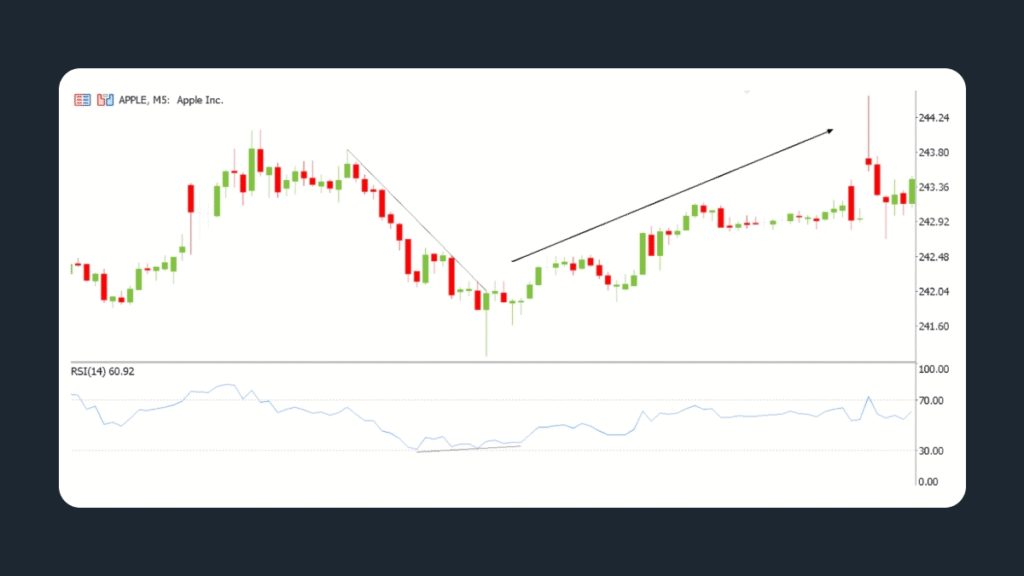
Case Study 2: Late-Day Reversal Using RSI Divergence
On Apple’s 5-minute chart, the stock dropped sharply from $243.80 to $241.60 (see downward black line). However, the RSI indicator below told a different story: instead of making a new low, it formed a higher low (black line on RSI), signaling a bullish divergence.
Around 15:00 ET, a candle with a long lower wick appeared—a reversal signal indicating that sellers were losing momentum. A long trade could have been entered near $241.80, with a stop placed just below the intraday low.
From that point, the price steadily rebounded, and the session closed near $243.50, offering a potential 1.5R to 2R profit with proper position sizing and risk management.
Takeaway: RSI and price divergence during power hour can be a strong reversal indicator. The crucial step is to wait for confirmation from price action rather than entering a trade prematurely.
Tools and Indicators for Power Hour Trading
To trade effectively during power hour, you need more than just chart patterns—you need the right tools to gauge market activity in real time. Key tools include:
VWAP (Volume-Weighted Average Price)
VWAP represents the “fair” average price for the day. Prices above VWAP indicate buyer control; below it signals seller dominance. During power hour, many institutional funds use VWAP as a benchmark, so bounces or breaks around it often provide high-probability trading signals.
Level 2 Quotes (Order Book)
Shows pending buy and sell orders at each price level. Watch for large bids or offers being added or withdrawn near the close—these can indicate potential big moves or fakeouts.
Time & Sales (The Tape)
Displays every executed trade. A surge of green (buy) or red (sell) orders, especially with large volume, often precedes breakouts. Monitoring the tape during power hour helps confirm whether volume is genuine or just noise.
Liquidity and Spreads
During volatile periods, spreads can widen and liquidity may drop, increasing slippage risk. Adjust position sizes accordingly and stick to highly liquid stocks.
Pro Tip: Combine VWAP for structure, Level 2 and tape for timing, and liquidity/spread awareness to size trades correctly.
Managing Risk During Power Hour
Power hour offers big opportunities, but it carries unique risks. Approach it cautiously:
Volatility and Slippage
Rapid price swings can lead to trades filling at worse prices than expected. Use limit orders instead of market orders to reduce this risk.
Position Sizing
Trade smaller positions than usual. A single volatile candle can wipe out oversized trades, so protect your capital while you adapt to the speed of power hour.
Stop-Losses
Always place a stop-loss before entering a trade. Moving or removing stops during high volatility is one of the fastest ways to lose money.
Daily Limits
Decide beforehand how much you’re willing to risk, and stick to it. Power hour can push traders into revenge trading; predefined limits help prevent excessive losses.
Remember: Trading power hour is optional. If unprepared, it’s better to wait than risk entering without context.
Order Types and the Closing Auction
The type of order you use is just as important as your entry price:
Market vs. Limit Orders
Market orders can experience significant slippage in fast-moving power hour markets. Limit orders protect your price and prevent chasing moves.
Bracket Orders
If your broker supports them, use brackets (entry + stop + profit target). This locks in your trading plan and reduces emotional mistakes under pressure.
MOC and LOC Orders
- Market-On-Close (MOC): Executes at the official closing price.
- Limit-On-Close (LOC): Executes at your set price or better during the closing auction.
Funds and institutional traders often use these to align with benchmarks or rebalance at the close.
Avoid Market Orders in the Last Minutes
Spreads can widen from 15:58–16:00 ET. Stick to limit, MOC, or LOC orders to avoid unexpected fills.
Long-Term Investor Considerations
Even long-term investors can benefit from power hour:
- Market-on-Close (MOC) or Limit-on-Close (LOC) Orders: Ensure execution at or near the official close.
- Higher Liquidity: Tighter spreads reduce transaction costs for large orders.
- Avoid Intraday Noise: Late-day trading helps bypass irrelevant mid-session volatility.
- Rebalancing and ETFs: Many funds adjust positions at the close, so prices often reflect consensus valuations.
The goal isn’t chasing intraday swings but efficiently opening or closing positions.
Power Hour Trading Plan
1. Pre-Market Preparation
- Track news, earnings, and overnight headlines.
- Build a watchlist of 3–5 high-volume, catalyst-driven stocks.
- Mark key levels: pre-market highs/lows, VWAP, support, and resistance zones.
2. Execution During Power Hour
- Trade only when your setup triggers (breakout, VWAP bounce, reversal).
- Use limit orders to manage slippage and reduce position size.
- Place a stop immediately and trail it as the trade moves in your favor.
- Take partial profits instead of aiming for extremes.
3. Post-Market Review
- Record every trade: entry, exit, stop, outcome, and rationale.
- Assess which setups worked or failed.
- Identify one improvement for the next session (e.g., tighter stops or better timing).
Consistency and review help build confidence and skill over time.
FAQ: Power Hour Trading
Is power hour suitable for beginners?
Yes, but start small. Focus on one or two setups and always use stop-losses.
Can small accounts trade effectively?
Yes. High liquidity helps small accounts enter and exit quickly, but avoid overtrading—quality beats quantity.
Does the PDT (Pattern Day Trader) rule apply?
Yes. Accounts under $25,000 are limited to three day trades within five business days. Power hour trades count toward this limit.
Can you short stocks during power hour?
Yes, if shares are available to borrow. Late-day squeezes can be intense, so size positions conservatively.
Power Hour Key Terms
VWAP (Volume-Weighted Average Price): Average price weighted by volume, used to gauge fair value.
ORB (Opening Range Breakout): Trade setup where entries occur when price breaks the first 15–30 minute range.
MOC/LOC Orders: Special orders executed at the market close; MOC guarantees execution, LOC only executes at your limit.
Liquidity: Ease of buying/selling without moving the price significantly.
Slippage: Difference between expected trade price and actual fill, common in fast-moving markets.
Get high-accuracy trading signals delivered directly to your Telegram. Subscribe to specialized packages tailored for the world’s top markets:
Free Crypto Signals Subscribe via Telegram
Free Forex Signals Subscribe via Telegram
Free VIP Signals (Gold, Oil, Forex, Bitcoin, Ethereum, Indices) Subscribe via Telegram
Free Trading Acoount Open With ORON LIMITED Signals (Gold, Oil, Forex, Bitcoin, Ethereum, Indices)
Open Account
Not profitable? Don’t worry! Join our copy trading system where we provide lower risk returns. Benefits of Joining Us:
-Lesser Risk as lot size is minimal
-Higher returns (approx. 5% to 10% monthly)
-Easy Deposit and Withdrawal with USDT using crypto wallets
-Lesser Drawdown
-Instant Support
-Invest Now and get guaranteed returns with us. DM us for more info❤️
-Start Now
*Copy Trading is free but we charge some percentage of profit as fees.*
Full VIP signals performance report for September 22–26, 2025:
