
Forex Trading: A Beginner’s Guide to How It Works
When people think of investment options, stocks and real estate often come to mind. However, Forex trading offers an exciting alternative. It involves buying and selling currencies to profit from their value fluctuations. The Foreign Exchange (Forex) market is one of the largest and most active financial markets in the world, with daily trades exceeding $6 trillion. Operating 24/7, it offers incredible flexibility and numerous opportunities for those willing to learn.
Table of Contents
- What is Forex Trading and How Does It Work?
- How Forex Trading Works
- The Role of Prop Firms in Forex Trading for Beginners
- Why Choose Forex Trading?
- Key Players in the Forex Market
- Getting Started with Forex Trading for Beginners
- Understanding Forex Trading Basics
- Types of Forex Markets
- Is There a Central Location for the Forex Market?
- When is the Forex Market Open for Trading?
- Best Times to Trade Forex
- Trading Sessions
- Key Forex Terms for Beginners
- Forex vs. Traditional Stocks
- Spot FX and Other Forex Markets
- Understanding Currency Pairs
- Which Currencies Are Traded?
- When Can Currencies Be Traded?
- How is Currency Pricing Determined?
- Understanding Leverage, Margin, and Other Key Terms
- Step-by-Step Guide to Starting Forex Trading
- The5ers: A Helpful Platform for Beginner Traders
- Common Forex Trading Mistakes to Avoid
- Types of Analysis in Forex
- Using Economic Indicators
- Helpful Forex Trading Tools
- The Bottom Line: Exploring Forex Trading Opportunities
What is Forex Trading and How Does It Work?
You might be wondering, What exactly is Forex trading, and how does it work? At its core, Forex trading is the act of exchanging one currency for another, aiming to profit from fluctuations in exchange rates. With its sheer size and constant activity, the Forex market offers significant potential for those who are prepared to dive in and learn the ropes.
How Forex Trading Works
Unlike other financial markets, the Forex market operates over-the-counter (OTC), meaning trades happen directly between parties without a centralized exchange. Forex trading takes place 24/7, across major global financial hubs such as New York, London, Tokyo, and Sydney, ensuring that there is always access to the market, no matter the time zone.
The Role of Prop Firms in Forex Trading for Beginners
For beginners, joining a Forex proprietary trading firm (prop firm) can be a game-changer. These firms provide aspiring traders with capital and structured resources to trade in live market conditions—without risking personal funds. Prop firms often offer training, tools, and performance evaluations, creating a supportive environment where traders can develop their skills, build confidence, and minimize financial risks.
Why Choose Forex Trading?
There are several reasons why Forex trading is an attractive option for investors:
- Liquidity: With over $6 trillion traded daily, Forex is the largest and most liquid financial market, allowing traders to enter and exit trades with ease.
- Flexibility: The Forex market is open 24 hours a day, five days a week, providing unmatched accessibility. Whether you’re a full-time trader or just getting started, you can trade at any time that suits your schedule.
- Low Transaction Costs: Forex typically has no commissions or hidden fees, aside from the spread, making it an affordable market to trade.
- Leverage: Forex trading offers high leverage, meaning traders can control larger positions with relatively small amounts of capital, amplifying both potential profits and risks.
- Profit from Rising and Falling Markets: Forex allows traders to profit whether markets are going up or down, offering opportunities in any market condition.
Key Players in the Forex Market
The Forex market consists of both institutional and retail participants, including:
- Central Banks: They influence currency values through monetary policies and interventions.
- Banks and Financial Institutions: They execute the highest volume of daily trades in the market.
- Corporations: Companies engage in Forex trading to hedge against currency fluctuations related to international trade.
- Retail Traders: Individual traders like you, who increasingly participate in Forex through online platforms.
Getting Started with Forex Trading for Beginners
For beginners, it’s important to familiarize yourself with basic strategies. Some common approaches include:
- Trend Trading: Focusing on larger price movements over time.
- Scalping: Aiming for small, quick profits from minor price fluctuations.
- Swing Trading: Seeking profits from price movements over a few days or weeks.
Also, understanding risk management is essential since Forex can be volatile. Familiarity with technical analysis, as well as the impact of economic news on currency prices, will also benefit new traders.
Understanding Forex Trading Basics
At its simplest, Forex trading is the exchange of one currency for another. Think of it like exchanging dollars for euros before traveling to Europe—only the goal here is to make a profit based on price changes. In Forex, you “buy” a currency pair if you expect its value to rise and “sell” it if you anticipate a decline. Currency pairs consist of two currencies, and their prices fluctuate due to global events, economic data, and market sentiment. Though Forex may seem complex at first, mastering the basics will make it much easier to understand.
Types of Forex Markets
There are several types of markets within the Forex space:
- Spot Market: Currencies are exchanged immediately at the current market price. Most retail trading happens here, capitalizing on daily price fluctuations.
- Forward Market: Involves contracts to buy or sell currencies at a predetermined price on a future date. Typically used by businesses to hedge against future price changes.
- Futures Market: Similar to forwards but standardized and traded on exchanges. Futures contracts are less common for retail traders but are used for speculation or hedging.
Most retail traders focus on the Spot Market, taking advantage of short-term price changes to find profitable opportunities.
Is There a Central Location for the Forex Market?
Unlike stock markets, there is no centralized exchange for Forex. The market is decentralized, with transactions occurring between banks, brokers, financial institutions, and individual traders. This makes Forex an over-the-counter (OTC) market, meaning that trades are executed via phone or electronic networks rather than through a centralized platform.
When is the Forex Market Open for Trading?
The Forex market operates 24 hours a day, five days a week. It opens on Sunday evening and closes on Friday night, spanning multiple trading sessions in key financial hubs like:
- Sydney: The market opens here, marking the start of the trading week.
- Tokyo: The Asian session begins in Tokyo, ideal for JPY, AUD, and NZD pairs.
- London: The European session is highly liquid, with EUR and GBP pairs seeing significant movement.
- New York: The U.S. session overlaps with the London session, resulting in high trading activity.
This global structure ensures continuous market access, no matter the time zone.
Best Times to Trade Forex
Though the market is open 24/7, the best times to trade are during periods of high liquidity—particularly when major trading sessions overlap. The London/New York overlap (1 p.m. to 5 p.m. UTC) is a particularly active period, with high volume and significant price movements.
Key Forex Terms for Beginners
Here are some essential terms you’ll encounter:
- Pip: The smallest price movement in a currency pair, typically 0.0001.
- Leverage: Enables you to control larger positions with a smaller capital investment (e.g., 100:1 leverage).
- Margin: The amount of collateral required to open a leveraged trade.
- Bid/Ask Price: The price at which buyers and sellers are willing to trade.
Forex vs. Traditional Stocks
Unlike traditional stock investments, which are often held for years, Forex trading focuses on short-term price movements. Forex traders generally engage in day trading, making decisions based on immediate market changes, while stock investors typically hold their positions long-term.
Understanding Currency Pairs
Currency pairs are composed of a base currency (e.g., EUR) and a quote currency (e.g., USD). The value of these pairs fluctuates based on economic indicators, market sentiment, and geopolitical events. There are three main types of currency pairs:
- Major Pairs: Include the U.S. dollar (e.g., EUR/USD).
- Minor Pairs: Do not include the U.S. dollar (e.g., EUR/GBP).
- Exotic Pairs: Feature one major currency and one from an emerging market (e.g., USD/TRY).
This rephrasing makes the information more concise, while still retaining the important details. Would you like me to continue rephrasing the rest of the content as well?
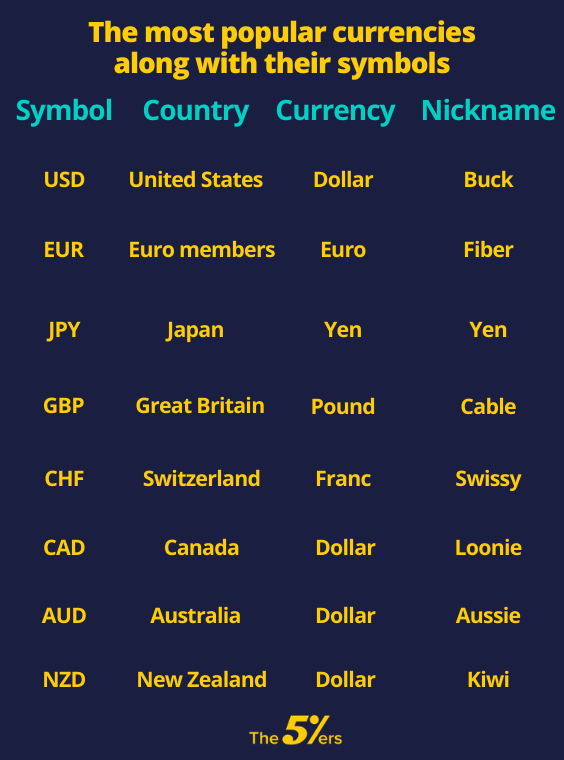
Forex Currency Symbols
Forex currency symbols are composed of three letters. The first two letters represent the country, while the third letter stands for the currency used in that country.
For those seeking more in-depth insights about currencies, the most traded currency pairs, or which currencies are best for trading, be sure to check out these articles: “Most Traded Currency Pairs” and “The Best Currency to Trade”.
When Can Currencies Be Traded?
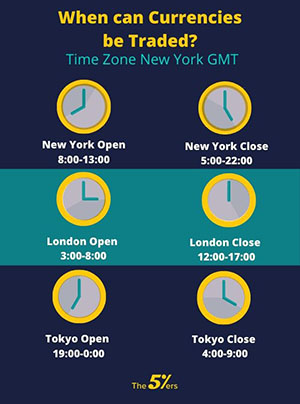
The Forex market operates 24 hours a day, five days a week, due to its global nature. However, different trading sessions affect the market in distinct ways:
- Asian Session (Tokyo): Opens around midnight UTC. Currency pairs involving JPY, AUD, and NZD typically see more activity during this session.
- European Session (London): Opens around 8 a.m. UTC. As one of the world’s major financial hubs, London brings increased liquidity and volatility, especially for EUR and GBP pairs.
- U.S. Session (New York): Begins around 1 p.m. UTC and overlaps with the London session, creating a peak period of high activity and heightened volatility.
How is Currency Pricing Determined?
The pricing of currencies is influenced by a variety of economic and political factors, including:
- Interest Rates: Currencies with higher interest rates tend to attract more investment, boosting their value.
- Inflation: Lower inflation rates generally lead to a stronger currency.
- Political Stability: A politically stable country is often associated with a stronger currency, as it tends to attract foreign investment.
Let me know if you’d like further adjustments!
Get high-accuracy trading signals delivered directly to your Telegram. Subscribe to specialized packages tailored for the world’s top markets:
Free Crypto Signals Subscribe via Telegram
Free Forex Signals Subscribe via Telegram
Free VIP Signals (Gold, Oil, Forex, Bitcoin, Ethereum, Indices) Subscribe via Telegram
Free Trading Acoount Open With ORON LIMITED Signals (Gold, Oil, Forex, Bitcoin, Ethereum, Indices)
Open Account
Not profitable? Don’t worry! Join our copy trading system where we provide lower risk returns. Benefits of Joining Us:
-Lesser Risk as lot size is minimal
-Higher returns (approx. 5% to 10% monthly)
-Easy Deposit and Withdrawal with USDT using crypto wallets
-Lesser Drawdown
-Instant Support
-Invest Now and get guaranteed returns with us. DM us for more info❤️
-Start Now
*Copy Trading is free but we charge some percentage of profit as fees.*
Full VIP signals performance report for September 22–26, 2025:
Brief Explanation of Leverage
Leverage in Forex trading allows traders to control larger positions with a relatively small investment. This can amplify both potential profits and risks.
For instance, Forex brokers often offer leverage ratios like 200:1. This means with a margin deposit of $50, a trader could control $10,000 worth of currencies. Similarly, a $500 deposit could allow trading with $100,000. While leverage presents opportunities for higher profits, it can also lead to significant losses if risk management is not properly implemented.
To test your knowledge about leverage, take our Leverage Test.
What is Margin?
Margin is the collateral required by a broker to open or maintain a Forex position. If the value of your open position declines and your account balance becomes insufficient to cover the margin, the broker will issue a margin call.
In this case, you will either need to deposit more funds or close the position. Brokers typically check margin availability before allowing any new trades.
Margin Call
A margin call occurs when your account balance falls below the required margin level. In this situation, the broker will automatically close some or all of your open positions to prevent the account from falling into a negative balance, especially during volatile market conditions.
For example, if you open a Forex account with $2,000 and take a position in EUR/USD with a margin requirement of $1,000, you would have $1,000 in usable margin. If your losses exceed this $1,000, you would receive a margin call.
What is a Pip?
A Pip (Percentage Interest Point) represents the smallest price movement in a currency pair. For example, 1 pip is equal to 0.0001 for EUR/USD and 0.01 for USD/JPY.
Pip Value
The value of a pip depends on the size of the position and the currency pair being traded. For example:
- For a standard lot in EUR/USD, the pip value is $10.
- For a mini lot, it’s $1.
- For a micro lot, it’s $0.10.
What is Spread?
The spread is the difference between the bid (buy) and ask (sell) price. For example, if EUR/USD is quoted at 1.3200/03, the spread is 3 pips. In order to break even, the price must move in your favor by at least the amount of the spread.
Rollover
A rollover refers to extending a position overnight, typically due to interest rate differentials between the two currencies in the pair. If you’re long on a currency with a higher interest rate, you may earn interest. Conversely, if you’re short, you will likely need to pay interest. Brokers generally handle rollovers automatically.
What is a Swap?
A Swap is the simultaneous purchase and sale of the same currency at different prices in a forward exchange. It involves agreeing to exchange currencies at a future date under specified terms.
What Does it Mean to Have a Long or Short Position?
- Long Position: A trader takes a long position when they expect the price of the currency to rise. The idea is to buy low and sell high.
- Short Position: A short position is taken when the trader expects the price to decrease. In this case, the goal is to sell high and buy low.
Risk-Reward Ratio
The Risk-Reward Ratio helps traders assess the potential losses in relation to the potential gains. For example, if the ratio is 1:4, this means risking 1 pip for a potential reward of 4 pips.
Difference Between an Intra-Day and an Overnight Position Quote
- Intra-Day Position: Positions opened at any time during the 24-hour period after the close of the broker’s normal trading hours (typically 4:30 p.m. EST).
- Overnight Position: Positions that remain open past the broker’s normal trading hours (4:30 p.m. EST) and are automatically rolled over to the next trading day at competitive rates based on interest rate differentials between the currencies.
Step-by-Step Guide to Starting Forex Trading for Beginners
- Choose a Reliable Broker or Prop Firm
Selecting a reputable broker or proprietary trading firm (prop firm) is crucial. The5ers offers a risk-free environment to learn and trade without needing your own capital, allowing beginners to practice with minimal financial risk. - Open a Demo Account
A demo account enables you to trade with virtual funds, helping you learn the platform and develop an understanding of the market dynamics without risking real money. - Learn Basic Trading Strategies
Beginners should start with simple strategies, such as:- Scalping: Small, quick trades aimed at frequent profits.
- Day Trading: Positions are closed within the same trading day.
- Swing Trading: Holding trades for a few days or weeks to capture larger market moves.
- Position Trading: A long-term approach often based on fundamental analysis.
- Use Proper Risk Management
Effective risk management is vital in Forex trading. Ensure you set stop-loss and take-profit orders to protect your capital. Aim to risk only 1-2% of your account balance on each trade. - Transition to Live Trading
Once you’re comfortable with the demo account, it’s time to transition to live trading. The5ers provides funded accounts, so you can trade with the firm’s capital while focusing on honing your strategy.
The5ers: A Supportive Platform for Trading Forex for Beginners
The5ers offers much more than just a trading platform; it’s a community built to support beginner traders through resources and funding opportunities:
- Capital Funding: Trade with The5ers’ funds, lowering your personal financial risk.
- Educational Resources: Access webinars, guides, and other learning materials to progress at your own pace.
- Real Market Exposure: Trade with The5ers’ funded accounts to gain real market experience.
Common Forex Trading Mistakes to Avoid
To become a successful trader, it’s important to avoid common mistakes, such as:
- Overtrading: Making too many trades, often driven by impulse.
- Neglecting Risk Management: Skipping stop-loss orders or proper risk controls can lead to significant losses.
- Emotional Trading: Letting emotions like fear or greed dictate your trades can lead to poor decisions. Stick to a clear strategy and plan.
Types of Analysis in Forex
Forex traders use two primary types of analysis:
- Technical Analysis: Involves studying price charts to identify trends and patterns. Tools like moving averages, RSI, and trendlines help predict market movements.
- Fundamental Analysis: Focuses on economic data such as GDP growth, employment figures, and inflation rates to assess currency strength.
Using Economic Indicators
Economic indicators play a significant role in influencing Forex prices. Key indicators to watch include:
- Interest Rates: Higher interest rates attract investment and typically strengthen a currency.
- Inflation: Lower inflation rates often lead to stronger currencies.
- Employment Data: Strong employment numbers can boost confidence in the economy, strengthening the currency.
Helpful Forex Trading Tools
Most brokers provide advanced trading platforms like MetaTrader 4 or MetaTrader 5 (MT4/MT5), which include charting tools and automated trading features. In addition to these platforms, The5ers also offers proprietary tools and resources to enhance your trading experience, including:
- Charting Tools: Popular candlestick charts for tracking price action.
- Trading Robots: Automated trading systems that execute trades based on predefined rules (though beginners are encouraged to start with manual trading).
The Bottom Line: A World of Opportunity in Trading Forex for Beginners
Forex trading offers immense opportunities for those who approach it with patience, discipline, and the right resources. While becoming a successful trader is challenging, a solid trading plan, effective risk management, and continuous learning make the journey manageable.
Subscribe to The5ers Newsletter for access to live webinars, trading ideas, strategies, and informative articles to help you master the essentials and grow in your trading career.
Explore our funding programs and visit our YouTube Channel for valuable trading insights. To further develop your skills, check out our Forex Trading Courses designed to elevate your expertise. With the right mindset and tools, you’ll be well-prepared to navigate the world’s largest financial market with confidence.
Let me know if you need any further edits!
Get high-accuracy trading signals delivered directly to your Telegram. Subscribe to specialized packages tailored for the world’s top markets:
Free Crypto Signals Subscribe via Telegram
Free Forex Signals Subscribe via Telegram
Free VIP Signals (Gold, Oil, Forex, Bitcoin, Ethereum, Indices) Subscribe via Telegram
Free Trading Acoount Open With ORON LIMITED Signals (Gold, Oil, Forex, Bitcoin, Ethereum, Indices)
Open Account
Not profitable? Don’t worry! Join our copy trading system where we provide lower risk returns. Benefits of Joining Us:
-Lesser Risk as lot size is minimal
-Higher returns (approx. 5% to 10% monthly)
-Easy Deposit and Withdrawal with USDT using crypto wallets
-Lesser Drawdown
-Instant Support
-Invest Now and get guaranteed returns with us. DM us for more info❤️
-Start Now
*Copy Trading is free but we charge some percentage of profit as fees.*
Full VIP signals performance report for September 22–26, 2025:
