
You’ve mastered the basics of Forex, and now the markets are moving—offering opportunities for short-term trades. While the first article laid the groundwork, it’s time to move into a true playbook. This guide delivers actionable short-term trading strategies and the tools you need to navigate the fast-moving currency markets with confidence. The shift from understanding what is happening and why, to mastering how to act, is a crucial step for any trader. This article equips you for that challenge. Our focus: practical application. We go beyond theory, showing you strategies that work in real-world trading, how to use indicators purposefully, and how to select tools tailored to your style. By the end, you’ll have a strategy grounded in skill and confidence—not guesswork.
Table of Contents
- Your Forex Playbook: Core Short-Term Trading Strategies
- Essential Tools: Indicators and Price Action
- Fundamentals of Short-Term Trading
- Choosing Platforms and Apps for Your Toolkit
- Reality Check: Can You Make Money?
- Final Thoughts: Building Your Trading Edge
Your Forex Playbook: Core Short-Term Trading Strategies
Profiting from quick price moves requires choosing strategies that match your personality, risk tolerance, and availability. Here are the main styles:
How to Approach Short-Term Trading
Successful short-term Forex trading requires a strategy—like scalping or day trading—combined with tools to identify signals and rigorous risk management. This is what separates disciplined traders from gamblers.
Scalping: Fast and Furious
Scalping is intense, rapid trading. You take small profits—sometimes just a few pips—multiple times throughout the day. This high-frequency approach demands constant focus. Tight spreads and fast execution are critical for success.
Order Flow Scalping:
This method monitors real-time buy and sell orders. Spot imbalances to anticipate price moves in seconds. For instance, a cluster of pending buy orders may signal a bounce, giving you a quick scalp opportunity.
Support/Resistance Scalping:
A classic approach, this strategy relies on key price levels. Trade when prices touch support or resistance for quick one-minute scalps. Even small moves can accumulate quickly.
Day Trading: The Daily Grind
Day trading is slightly less intense than scalping. The key rule: close all positions before the day ends to avoid overnight risk. Effective strategies include:
- Intraday Trend Following: Identify short-term trends on 5- or 15-minute charts and trade in that direction, confirming with higher timeframe charts and indicators like moving averages.
- Counter-Trend/Reversal: Catch a trend reversal early using momentum shifts or overbought/oversold indicators like RSI.
- Breakout Strategies: Trade when price breaks significant support or resistance for fast moves.
- News Trading: High-reward but risky. Major economic releases create volatility. Successful news trading requires speed, sharp instincts, and understanding market expectations.
Swing Trading: The Longer Game
Swing trading focuses on larger moves, holding positions for several days or weeks. It’s less hectic than scalping or day trading, making it ideal for strategic, screen-light traders.
- Chart Patterns: Use 4-hour or daily charts to spot patterns like flags, triangles, or channels for trend projections and target setting.
- Correlation Trading: Track correlated pairs (e.g., EUR/USD and GBP/USD). Use one pair to confirm signals in another, improving trade confidence.
Choosing Your Style
There’s no single best approach for short-term Forex trading. Your ideal strategy depends on your schedule, temperament, and discipline. The goal is to find a method you can consistently execute while managing risk effectively.

Your Essential Tools: Indicators and Price Action
Think of technical analysis as your trading compass. It helps make sense of the charts and guides your next moves. Once you understand how to use the tools, you can trade with intention rather than guesswork.
What’s the Best Indicator for Short-Term Trading?
A common misconception is that a single indicator will solve all trading problems. There’s no one “best” tool for short-term trading. Successful traders in 2025 combine multiple indicators—like Moving Averages, RSI, MACD, and Bollinger Bands—to confirm signals and get a full picture of market behavior.
Price Action: Reading the Chart Naked
Before diving into indicators, it’s essential to understand price action—the art of interpreting candlesticks and chart patterns directly, without relying on extra tools. Price action is the purest form of technical analysis and forms the foundation for many profitable short-term trading strategies.
Your Go-To Indicators
Your go-to indicators are the ones you trust to guide your trades. They’re not magic—they’re part of your trading routine and language.
Moving Averages (MA, EMA):
Smooth out price movements to reveal trends. Watch for crossovers, slope changes, or when price moves above or below the average.
Relative Strength Index (RSI):
Measures momentum. Values above 70 may signal overbought conditions; below 30, oversold. Look for divergences as clues for potential reversals.
Moving Average Convergence Divergence (MACD):
Combines trend and momentum analysis. Crossovers of the MACD and signal lines indicate shifts, while divergences with price can highlight upcoming changes.
Bollinger Bands:
Track volatility. Price touching the outer bands may signal a reversal—or, in the case of strong momentum, a breakout. Narrow bands often precede significant moves.
Fibonacci Retracements/Extensions:
Highlight potential reversal or target zones. Use retracements to identify pullback levels and extensions to plan take-profits along a trend.
The Rule for Short-Term Trading
Successful traders don’t rely on guesswork. They follow a plan that defines entry, exit, risk levels, and emotional discipline in volatile markets. Indicators support the plan—they don’t make the decisions.
The Short-Term Trading Model
A structured approach ensures consistency. A short-term trading model is essentially a checklist: it combines technical tools, clear rules for entering and exiting trades, and risk management guidelines for executing trades within tight timeframes.
Example:
“I’ll enter only when the 9 EMA is above the 20 EMA to confirm the trend, and RSI drops below 30 for an entry. My stop-loss is 20 pips, and my take-profit is 40.”
The “3-5-7 Rule” is another example, using specific moving averages to gauge trend and momentum. A trading model keeps decisions disciplined, repeatable, and aligned with your strategy.
Fundamentals for Short-Term Trading
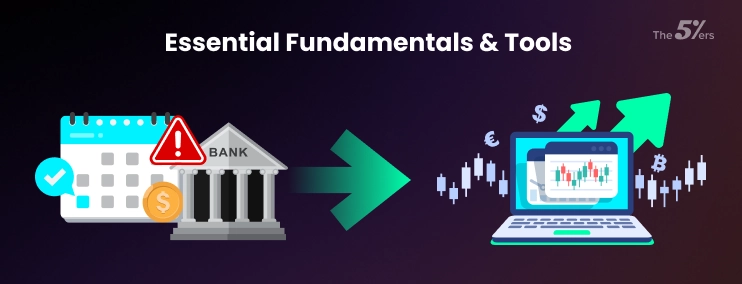
Even if your focus is on short-term trades, you can’t ignore major economic events. These releases often trigger the big price swings that create your trading opportunities.
The Economic Calendar:
Following the economic calendar is essential. It highlights key news releases such as CPI (inflation) reports or central bank rate decisions. Markets react strongly to surprises, so knowing the market’s “expected” figures in advance is critical. Volatility stems from the gap between actual results and expectations, giving you potential trading opportunities.
Central Bank Announcements:
When central bankers speak, traders listen. Statements on interest rates or monetary policy can instantly move currencies. You’ll often see sharp, immediate moves on the charts as the market digests new information.
A Word of Caution:
News trading is fast-paced and risky. Prices can move against you as quickly as they move in your favor. It’s wise to master other strategies before attempting news-based trades.
Your Toolkit: Picking Platforms and Apps
Technology is just as important as your strategy, especially for short-term trading where speed is crucial.
Choosing the Right Platform:
A good platform can give you a significant edge. Look for tight spreads, rapid execution, advanced charting tools, and access to a wide range of currency pairs. MT5 and cTrader are popular choices among short-term traders.
Fast Execution:
Slippage—being filled at a worse price than expected—can eat into profits. Fast execution is essential to minimize this risk, particularly for trades that last only minutes or hours.
Trading Apps:
Mobile trading apps offer flexibility, allowing you to manage positions when away from your desk. Ensure your chosen app has all the features of the desktop version; a stripped-down app can leave you at a disadvantage. The best apps mirror the desktop experience, providing full control on the go.

The Reality Check: Can You Make Money?
The idea of quick profits is tempting, but it’s important to stay grounded.
Do short-term traders actually make money?
Short-term trading is challenging. While some traders do succeed, many do not. Success requires skill, emotional discipline, and a serious commitment to learning. Chasing rapid gains without a clear plan is a fast track to failure.
How do day traders generate income?
Forex day traders profit by capitalizing on daily price movements. They execute multiple buy and sell trades on currency pairs, closing all positions by the end of the day to avoid overnight risks and market gaps. The goal is to accumulate small, consistent gains over time—trading is a game of steady wins, not one-off home runs.
Understanding short-term trading income
Earnings from short-term trading come from frequent, rapid trades. It’s important to remember that these profits are considered capital gains for tax purposes. Maintaining accurate records from the start is essential.
Final Words: Build Your Trading Edge
Successful short-term trading isn’t about a single “magic” indicator or secret trick. It’s about having a clear strategy, using your tools effectively, and continuously refining your skills.
We’ve explored a range of strategies—from scalping to swing trading—and shown you how to build a structured trading model. Ultimately, your success depends on discipline. Our advice: start with a demo account. Practice until you establish a reliable routine that you can follow confidently. Only then should you consider trading with real money.
Stay patient, stay focused, and treat trading as the serious challenge it is. Consistency and preparation are your true edge.
Get high-accuracy trading signals delivered directly to your Telegram. Subscribe to specialized packages tailored for the world’s top markets:
Free Crypto Signals Subscribe via Telegram
Free Forex Signals Subscribe via Telegram
Free VIP Signals (Gold, Oil, Forex, Bitcoin, Ethereum, Indices) Subscribe via Telegram
Free Trading Acoount Open With ORON LIMITED Signals (Gold, Oil, Forex, Bitcoin, Ethereum, Indices)
Open Account
Not profitable? Don’t worry! Join our copy trading system where we provide lower risk returns. Benefits of Joining Us:
-Lesser Risk as lot size is minimal
-Higher returns (approx. 5% to 10% monthly)
-Easy Deposit and Withdrawal with USDT using crypto wallets
-Lesser Drawdown
-Instant Support
-Invest Now and get guaranteed returns with us. DM us for more info❤️
-Start Now
*Copy Trading is free but we charge some percentage of profit as fees.*
Full VIP signals performance report for September 22–26, 2025:
